Sovereign Trust Infrastructure for the Artificial Intelligence Era.
AI Synapse Technologies designs and operates sovereign governance infrastructure enabling governments, critical infrastructure, and regulated enterprises to adopt AI with verifiable legal accountability.
Governance is not advisory. It is structural.
Artificial intelligence is moving from isolated experiments to decisions affecting citizens, patients, financial stability, and public services. Policy PDFs and post-hoc logs cannot govern live AI execution. Institutions require sovereign control embedded directly into infrastructure.
Read our Thesis & Design Principles“Trust is built through verifiable architecture and sustained through technological sovereignty.”
Who we are — and what we are not
- A European technology holding dedicated exclusively to sovereign AI governance and enforcement infrastructure.
- Architects of system-level trust layers designed for regulated, mission-critical, and public-sector environments.
- Independent builders of vendor-neutral, cryptographically verifiable governance stacks operating under European law.
- Not an AI model provider competing with foundation models or locking clients into proprietary LLMs.
- Not a management consultancy selling static compliance slide decks or PDF checklists.
- Not a third-party cloud data broker capturing institutional prompts or citizen data.
- Not a passive observability dashboard that merely reports violations after harm has occurred.
- Not a generic perimeter firewall blind to AI regulation, FRIA mandates, or evidentiary auditability.
ORION Trust OS
All of our governance engineering — the 9-Gate enforcement pipeline, FRIA compliance engine, bidirectional privacy & adversarial defense, multi-model orchestration, and ECDSA cryptographic audit ledger — lives inside one unified operating system.
- Dedicated product portal with interactive 9-Gate architecture simulator
- Built specifically for Public Administrations (AAPP) & Regulated Enterprises
- Native EU AI Act (Art. 50 live; Annex III Dec 2, 2027 · Reg. EU 2026/1744) & GDPR compliance by architecture

Built for institutions where failure is not an option
We concentrate exclusively on environments with strict regulatory accountability, citizen impact, or critical systemic risk.
Public Administrations & Government
Central ministries, regional governments, municipalities, and public agencies navigating EU AI Act Annex III & mandatory Art. 27 FRIA.
Critical Infrastructure
Energy grids, water, transport, telecommunications, and logistics operators requiring fail-closed controls and lifecycle auditability.
Regulated Enterprises
Banking, insurance, healthcare, and legal institutions enforcing strict PII/PHI sovereignty across multiple AI providers.
Active member of the Digital Catalonia Alliance
From our headquarters in Barcelona, AI Synapse Technologies participates actively in European digital sovereignty, GovTech, and cybersecurity communities.
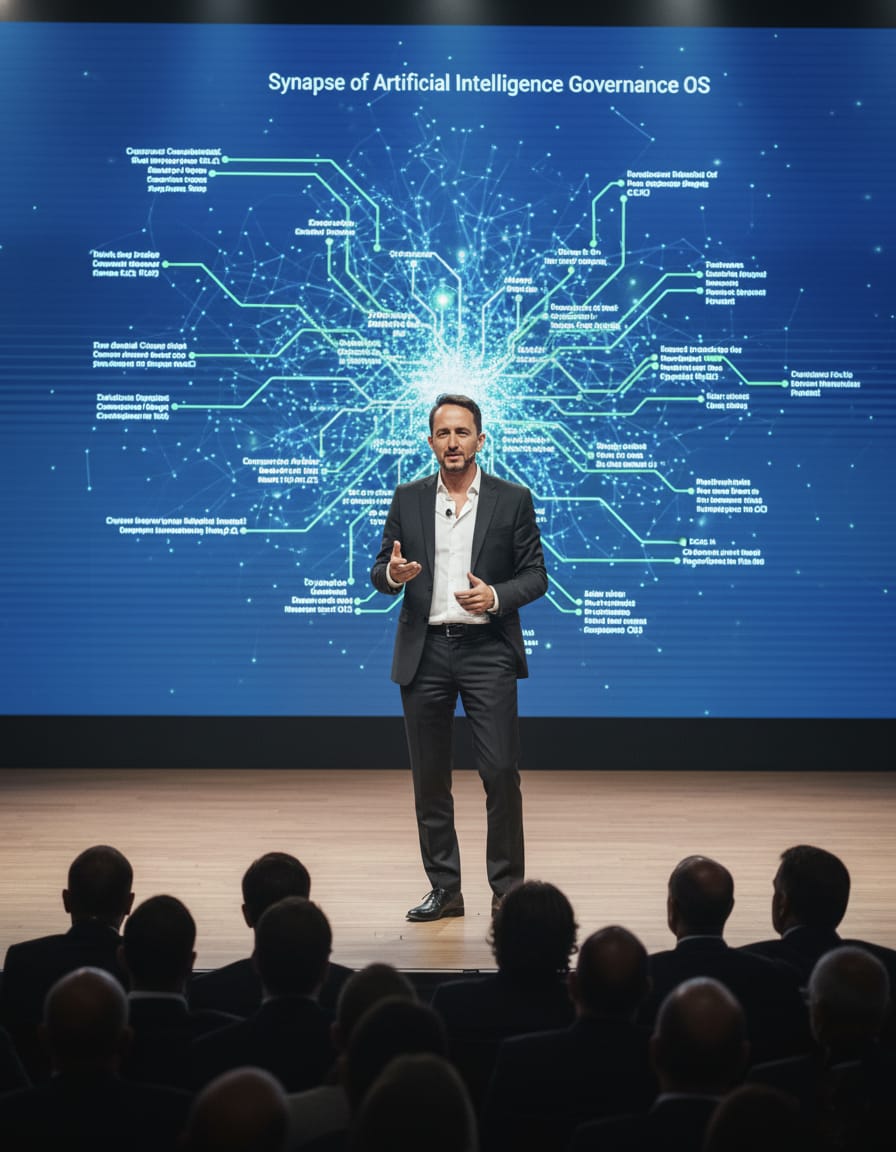
Alejandro Fabián
Founder, Chief Executive Officer & Chief Architect
“Governance is not a constraint on innovation; it is the infrastructure that makes sustainable innovation possible.”

Position Papers & Regulatory Briefings
EU AI Act Roadmap for Public Administrations: Active 2026 Rules & High-Risk Deadlines After Reg. (EU) 2026/1744
Updated November 2026 regulatory analysis covering Reg. (EU) 2024/1689 as amended by Digital Omnibus Reg. (EU) 2026/1744: active Art. 4/Art. 5 (Feb 2025), GPAI & governance (Aug 2025), Art. 50 transparency (Aug 2026), targeted Reg. (EU) 2026/1744 prohibitions (Dec 2, 2026), Annex III & FRIA deadline (Dec 2, 2027), AESIA supervision, and exact Art. 99 penalties.
FRIA After the EU AI Office Template (Nov 2026): Why Impact Assessment Must Be Infrastructure, Not Just a Form
Integrates the EU AI Office & FRA draft FRIA template (Nov 16, 2026), exact statutory scope under Art. 27(1) (public bodies, private operators of public services, creditworthiness & life/health insurance deployers under Annex III 5(b)–(c)), Art. 27(2) update triggers, GDPR Art. 35 DPIA cross-referencing (Art. 27(4)), and the 5 architectural layers of operational FRIA.
Audit Trail in High-Risk AI Systems: Technical Requirements of Articles 12, 19(1) & 26(6) EU AI Act
Clarifies the exact legal interplay between Art. 12 (automatic logging capability), Art. 19(1) & Art. 26(6) (general minimum 6-month retention under direct control, subject to statutory conditions/exceptions and longer sectoral laws such as DORA), serious-incident reporting (Art. 73), market surveillance investigations (Arts. 74 et seq.), and ECDSA + SHA-256 immutability.